Projects · m-dash
Know what’s left.
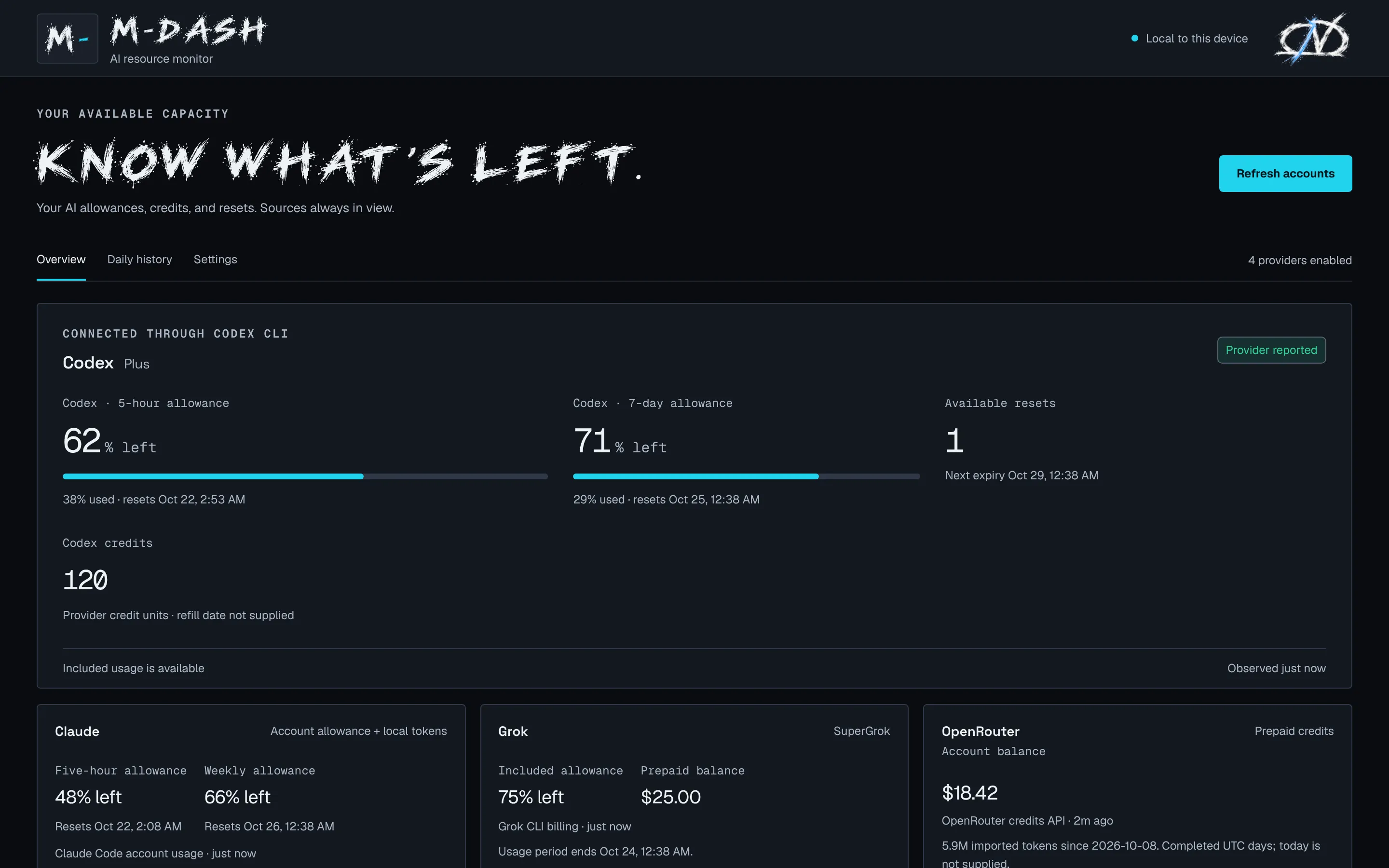
m-dash is a free desktop dashboard that shows how much of your Codex, Claude, Grok and OpenRouter allowance is left, and when it resets. It runs on your own computer.
What it does
- Shows every allowance in one place, with reset times and credits.
- Keeps up to four allowance bars in a compact strip and in your Windows tray or Mac menu bar.
- Keeps a local history and estimates when you’ll run out, once it has enough recent readings.
- Says when a reading is missing or stale instead of guessing.
- Optionally, when your Claude five-hour window has expired, sends a small ping to start the next one. It’s off by default and uses a little of your Claude usage.

Private by design
m-dash has no account, cloud service or analytics. Each provider’s own command-line tool handles sign-in, and an OpenRouter key goes in your system keychain. Your history stays in a database on your computer.
Download
| Platform | What you get |
|---|---|
| Windows x64 | Installer. It isn’t code-signed, so SmartScreen may warn on first run. |
| macOS 12+ on Apple Silicon | Signed and notarized disk image. |
| Linux | Build from source. |
Every release lists SHA-256 checksums and GitHub build attestations. How to verify a download.
Why I built it
I am typically running 3 or 4 harnesses on each of 3 platforms using four or five providers. Keeping track of usage limits, reset dates/times and API credits is truly challenging.
Having that information constantly at hand saves me from interrupting flow to check limits, and makes proactive decisions about which workstreams go where much simpler. Having my 5-hour window reset automatically for me helps keep me unblocked on my early morning sessions.
Managing models and harnesses is hard enough; managing usage shouldn’t be.
Apache-2.0. The m-dash name and CND brand assets are covered separately; see TRADEMARKS.md. m-dash is an independent project and isn’t affiliated with OpenAI, Anthropic, xAI or OpenRouter. Questions or security reports: [email protected].